
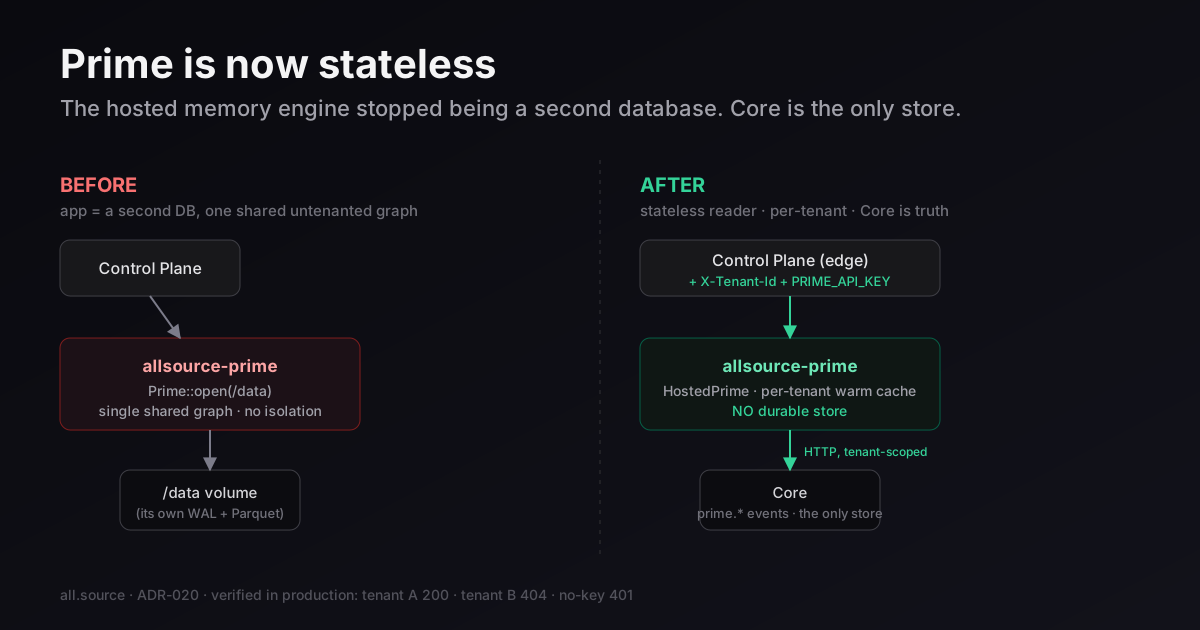

AllSource Prime is the agent-memory engine — graph, vectors, recall. In production it shipped as its own service, allsource-prime, with its own WAL + Parquet store on a Fly volume.
Which meant we had two databases. Core (our event store) was one. The Prime app was a second, accidental one.
We just deleted the second database without deleting Prime. This is how.
The one line that caused it
Prime was hard-wired to a concrete, local store:
pub struct Prime {
    core: EmbeddedCore,   // ← in-process WAL/Parquet/DashMap
    // …projections…
}
The hosted app did Prime::open("/data"). So the app was a Core: one shared graph, on a volume, behind a tenant-authenticated edge. We probed prod to confirm the damage:
POST https://allsource-prime.fly.dev/api/v1/prime/nodes   (no auth)
→ 201 Created
An unauthenticated write, into a single store shared across every tenant. Not a leak waiting to happen — a leak that had happened, structurally.
The principle we were violating
Core IS the database. Everything else is a stateless service that talks to Core over the network.
The Query Service already lives by this — it holds no event data; it calls Core over HTTP and scopes every request to a tenant. So does chronis. The hosted Prime app was the one service that owned a store. The fix was to make it behave like the Query Service.
The new flow
<img src="/assets/blog/prime-stateless-flow.svg" alt="Request flow: client → Control Plane (stamps tenant + key) → stateless prime app → Core, with per-tenant fold" style={{ width: "100%", borderRadius: "12px", margin: "1rem 0" }} />
Five pieces, smallest blast radius we could manage:
-
An
EventStoretrait. Prime'scorefield becameArc<dyn EventStore>—ingest/query/shutdown. Two implementations:EmbeddedCore(local, for the stdio dev binary — untouched) and a newHttpCorethat reads/writes a remote Core over HTTP, tenant-scoped. -
Store-less projections. A
GraphProjectionsbundle builds Prime's full projection set from a plain list of events —reconstruct → Projection::process— with no backing store. This is the fold that used to require a local event log. -
A per-tenant warm cache. The load-bearing piece (more below).
-
HostedPrime— a new type (sofacade::Primeand the local-first path stay exactly as they were) that composes the above into a stateless engine with full graph + vector + recall parity. Every method takes an explicittenant. -
Routing + auth. The Control Plane — the public edge — forwards
/api/v1/prime/*to the app, stamping a trustedX-Tenant-Idheader and a sharedPRIME_API_KEYbearer. The app refuses to serve tenants unless that key is set (so the header can't be spoofed) and gates its REST surface behind it.
Now tenant isolation isn't a feature we add — it's a property of querying Core scoped to the caller's tenant. Core already filters events by tenant_id. Each tenant gets its own in-memory projection bundle, folded from its own events. There is no shared store to leak.
The load-bearing trick: a per-tenant warm cache
Statelessness has an obvious failure mode for a memory engine: if every request re-queries a tenant's entire event history from a remote Core and rebuilds an HNSW vector index, recall latency suffers. Core's published 11.9μs p99 indexed-read benchmark does not include graph/vector rebuilds, so Prime needs a warm path of its own.
So TenantProjectionCache keeps each tenant's materialized projections warm in memory:
- Cache miss → query Core for that tenant's
prime.*events, fold them, cache the bundle. - Cache hit → serve the warm bundle.
- Write → append the event to Core and update the warm bundle in place.
- Bound memory → LRU eviction; stale entries re-hydrate.
This is the exact shape of Core's own per-tenant warm-set (lazy hydration + LRU) — just over HTTP instead of Parquet. Restart? The cache rebuilds from Core on demand. Core is the durable truth; the app is a cache.
The bug we caught in production
We deployed, then verified live. Most of it was clean — tenant A writes and reads its node (200), tenant B gets a 404 for A's node (isolation), no-key gets a 401 (the gate).
Then stats lied. A fresh tenant that created 2 nodes + 1 edge reported 3 nodes / 4 events.
The cause was a write path that did ingest → get_or_hydrate → apply. On a cold tenant, get_or_hydrate pulled the just-ingested event back from Core (it's already persisted) and then apply folded the same event in again. Entity-keyed projections (node state, the graph view) were idempotent and stayed correct — so the graph looked fine and only the counters inflated, which is exactly the kind of bug that survives a green test suite.
The fix is a deletion: drop the hydrate-before-apply. cache.apply already no-ops when the tenant is cold, so warm tenants apply once (correct) and cold tenants stay cold — the next read hydrates from Core, which has the event. One apply, never two.
A real-Core end-to-end test (a live EmbeddedCore behind a thin HTTP shim, two HostedPrime instances, the reader cold) now guards it. Redeployed; prod stats are exact.
What shipped
The app now owns no durable store. The flow, end to end:
client (tenant key)
  → Control Plane            (authenticate, resolve tenant)
  → +X-Tenant-Id +PRIME_API_KEY
  → allsource-prime          (HostedPrime, per-tenant warm cache, no store)
  → Core                     (tenant-stamped prime.* events — the only store)
Verified in production:
| check | result |
|---|---|
| unauthenticated REST write | 401 (was 201) |
| tenant A write + read | 200 |
| tenant B reads A's node | 404 — isolated |
| stats after 2 nodes + 1 edge | exact (2 / 3) |
Prime is still Prime — same graph, vectors, and recall served from a warm cache. End-to-end recall depends on corpus, query strategy, cache state, and hardware. It just stopped pretending to be a database.
Deep dive: ADR-020 — Prime as a Stateless Engine over Core.