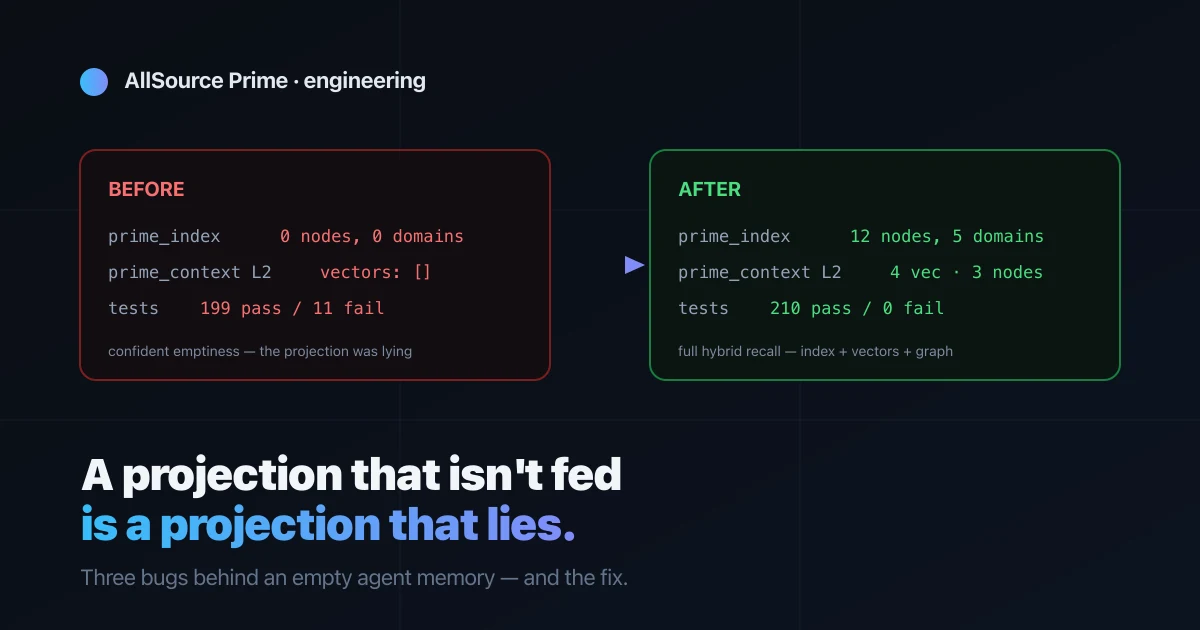

You record a decision into your agent's memory. You ask for it back. You get nothing.
Not an error. Not a slow query. An empty index — 0 nodes, 0 domains — sitting
next to a store that visibly held a dozen records. prime_stats said 12 nodes.
prime_index said zero. Both were reading the "same" memory.
This is the story of three bugs behind that contradiction in AllSource Prime, the event-sourcing lesson that ties them together, and the verified before/after.
The symptom
Prime is an agent-memory engine: record facts as nodes, embed them for semantic search, recall the relevant slice on demand. Two retrieval surfaces matter here:
prime_index— a compressed, token-counted summary of everything the agent knows, organized by domain. The thing you inject into a system prompt.prime_context— tiered retrieval. L0 = stats only, L1 = recent context, L2 = full hybrid recall (index + vectors + graph).
Both came back empty for data recorded through the live tool path:
prime_stats   ->  { "total_nodes": 12, "nodes_by_type": { "voice": 12 } }
prime_index   ->  "# Knowledge Index\n\n_0 nodes, 0 domains, 0 cross-domain links_"
prime_recall (direct vector search) worked fine. So the data was there and
embedded — but the index and context surfaces couldn't see it. Three separate
defects, all hiding behind that one symptom.
Bug 1: a projection that was never fed
Prime is event-sourced. State lives in projections — in-memory structures
rebuilt by replaying the event log. The compressed index is built from a
DomainIndexProjection. The facade registers every projection with the store and
backfills it from history... except this one.
The recall engine was handed a fresh, empty DomainIndexProjection::new() —
never registered with the store, never backfilled, never fed a single live write.
The code comment even said so, cheerfully:
// A fresh DomainIndexProjection is created (RecallEngine registers it separately).It didn't register it separately. Nothing did. So the index projection sat at zero forever while every other projection tracked reality.
The event-sourcing lesson, stated once: in an event-sourced system, a projection is only as live as its subscription. An unregistered, un-backfilled projection isn't "empty" — it's lying, and it will keep lying with total confidence. The fix is boring and correct: register it and backfill it like every sibling, then share that one instance with the recall engine.
let _ = store.register_projection_with_backfill(&(Arc::clone(&domain_index) as DynProj));
// ...and hand the SAME Arc to the recall engine, not a fresh empty one.
Bug 2: reading the wrong shape
With the projection finally fed, it was still empty. Because it was reading a payload shape that the writer never produced.
add_node emits:
{ "id": "…", "node_type": "voice", "properties": { "domain": "architecture" } }The projection read:
event.payload.get("domain")    // top-level — not where it lives
event.payload.get("node_id")  // wrong key — it's "id"
domain lives under properties; the id key is id, not node_id. Every lookup
missed, so every node was silently dropped from the index. Same mismatch in the
cross-domain projection (which also keyed nodes by bare id instead of the
entity_id that edges actually reference).
The fix reads the canonical shape with a legacy fallback:
let domain = event.payload.get("properties").and_then(|p| p.get("domain"))
    .and_then(Value::as_str)
    .or_else(|| event.payload.get("domain").and_then(Value::as_str));
Why the tests were green
Here's the uncomfortable part. The projection had tests. They passed. They passed because the test fixtures hand-built events in the wrong shape — the same wrong shape the buggy code expected. The tests and the bug agreed with each other and both disagreed with production.
A test that constructs its own input in the format the code-under-test happens to
want isn't testing the contract — it's testing a tautology. The fix included
rewriting the fixtures to emit the real add_node/add_edge payloads. That
turned 11 green-on-a-lie tests into tests that actually exercise the writer's
output. (210 prime tests pass on the corrected fixtures.)
Bug 3: the half-wired hybrid tier
Index fixed, one surface remained thin. prime_context L2 advertises "full
hybrid recall — index + vectors + graph," but returned the index with an empty
vectors/nodes list. A standing // TODO: vector search integration.
The cause was architectural, not a typo: the recall engine owns the compressed index but not the vector store (that lives on the Prime facade, behind an optional feature). So the engine couldn't fill the vector arm — it didn't have one.
The fix wires the two together at the layer that has both: for an L2 query, embed the text in-process, run the facade's working vector + graph recall, and attach those hits to the context response. L0/L1 stay untouched (they don't do vector recall by design), and a recall failure falls back to the index alone rather than sinking the whole call.
Before and after
All figures below are verbatim from the allsource-prime binary over stdio,
against a throwaway data dir — same harness, before the fix vs after.
| surface | before | after |
|---|---|---|
prime_index |
0 nodes, 0 domains |
12 nodes, 5 domains, 77 tokens |
prime_context L2 |
index only, vectors: [] |
index + 4 vectors + 3 graph nodes |
prime_recall top hit |
0.76 (already worked) | 0.76 (unchanged) |
| prime test suite | 199 pass / 11 fail | 210 pass / 0 fail |
The recall query that returned nothing now returns the right slice by meaning. A reworded prompt — "should I add a database when availability hurts?" — surfaces the recorded contrarian take "add a database is usually the wrong fix" as the top node at 0.73, with the durability and event-sourcing facets right behind it.
The takeaway
Three bugs, one root pattern: the read path and the write path drifted, and nothing forced them back together. An unregistered projection, a payload-shape mismatch, and a half-wired tier all produced the same lie — confident emptiness — and a test suite that validated the lie instead of the contract let it survive a release.
If you build on event sourcing: register and backfill every projection that anything reads; assert your projections against the writer's real output, not a fixture you invented to match the reader; and when a tier claims "full hybrid," make a test prove all three arms come back non-empty.
To test the durability claim yourself, run the local restart proof and check both recall and source-event history after reopening the data directory. See the agent-memory solution for the Core and Prime roles behind that flow.
Prime's recall — prime_index, prime_context across all tiers, and
prime_recall — now works end to end. If you're building agent memory on
AllSource, the compressed index you inject is the one your agent actually has.