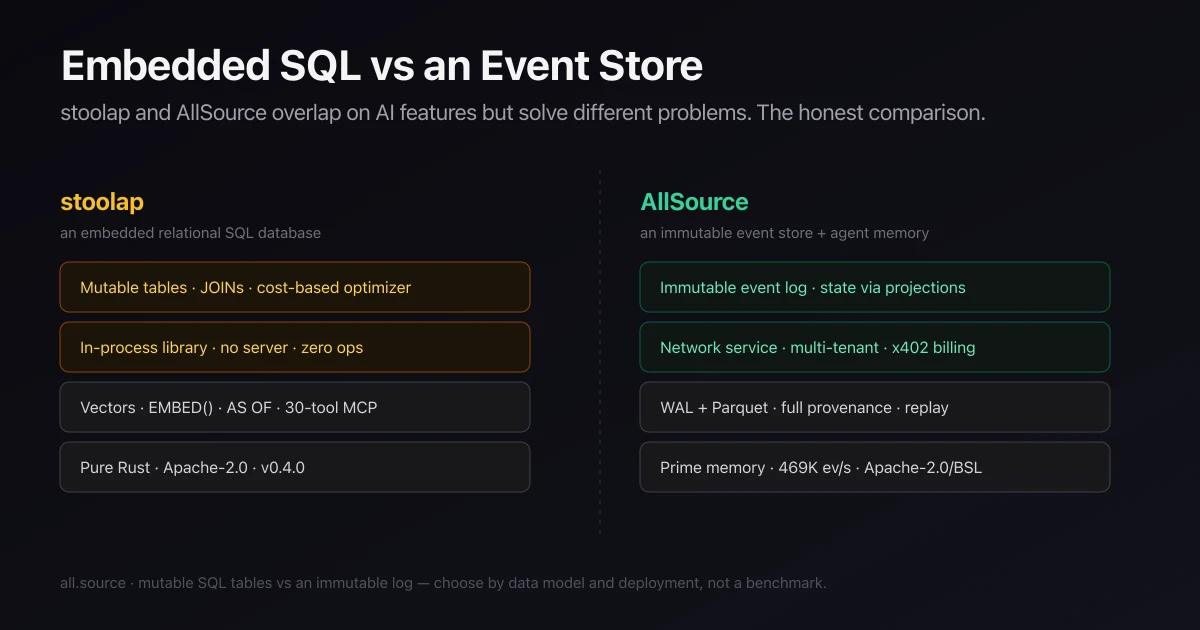

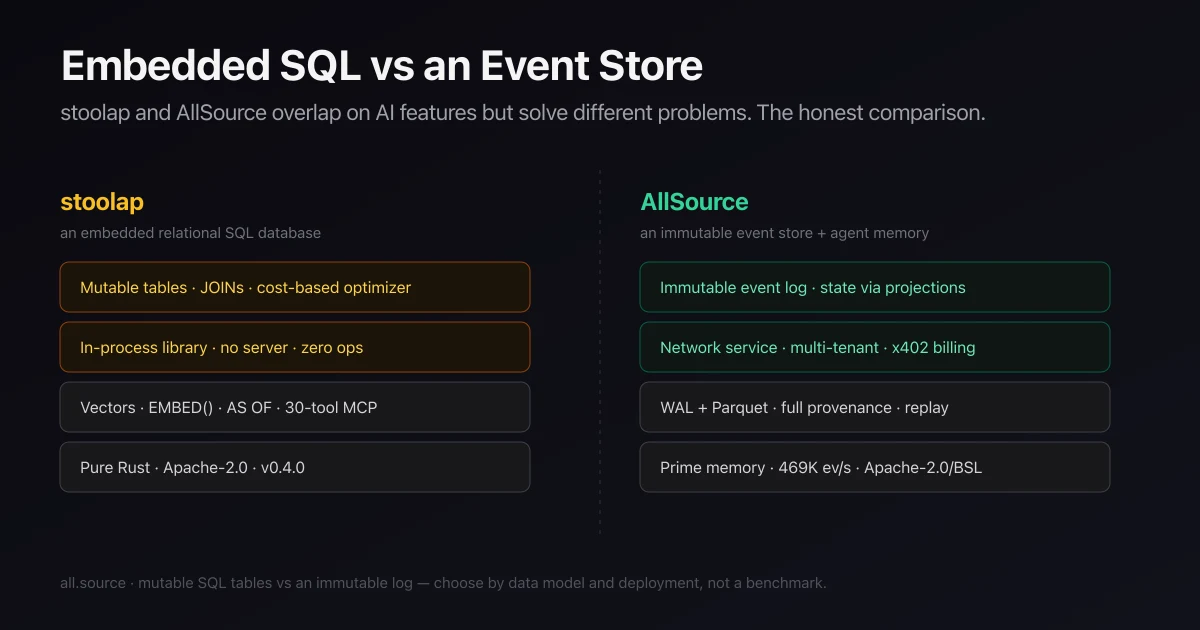
Most "X vs Y database" posts open as a cage match and quietly end as a shrug, because the two tools were never in the same weight class. stoolap and AllSource are exactly that case — and the honest thing to do is say so on line one.
stoolap is an embedded relational SQL database. You cargo add stoolap, write CREATE TABLE / INSERT / SELECT, and it runs inside your process. Mutable rows, MVCC, a cost-based optimizer, full SQL with JOINs and window functions. It is a library, like SQLite or DuckDB — there is no server mode.
AllSource is an append-only event store plus an agent-memory engine (Prime) and a hosted multi-tenant SaaS. Data is an immutable WAL + Parquet log; "current state" is a projection you fold from events. Core runs as a Rust server on the network (and can be embedded as a library too).
They share an AI-era pitch — both ship vector search, built-in embeddings, time-travel, and an MCP server — but they are answering different questions. This post lays out where they overlap, where they genuinely diverge, and a like-for-like benchmark we actually ran on one laptop. Where stoolap is the better tool, we say so plainly: a comparison with no honest concessions is just marketing, and you'd be right to ignore it.
What stoolap is
stoolap calls itself "A Modern Embedded SQL Database in Pure Rust." The Database-of-Databases encyclopedia classifies it as relational, shared-everything, MVCC; an independent Better Stack review calls it "an embedded OLAP database." All of those are fair.
Concretely, it gives you:
- Full SQL — JOINs, subqueries, CTEs, window functions, 101+ built-in functions — over mutable tables you
UPDATEandDELETE. - ACID with MVCC and snapshot isolation, a cost-based optimizer, and parallel query execution (Rayon).
- Multiple index types: B-tree, Hash, Bitmap, multi-column, and HNSW for vectors.
- Native
VECTOR(N)columns and a built-inEMBED()function — semantic search in SQL, with no external embedding API. AS OFtime-travel (AS OF TIMESTAMP/AS OF TRANSACTION) backed by MVCC.- A storage engine with an in-memory MVCC hot buffer + WAL for active writes, and immutable columnar cold files (zone maps, bloom filters, dictionary encoding, LZ4) — an Iceberg/Delta-flavoured design.
- Broad language reach from one engine: Rust, Node.js, Python, Go, Java, C#, PHP, Ruby, Swift, a C FFI, WASM — and a first-party MCP server (
@stoolap/mcp).
It is Apache-2.0, ~1.2k stars, and at v0.4.0 (released 2026-04-01) — a young project with a single primary maintainer. The same independent review notes it is "still in its early days, as evidenced by the NPM installation bug." Worth knowing: some older pages describe stoolap as "pure Go" — that's historical. It began as a Go prototype and migrated to Rust; the current crate is 99.8% Rust.
stoolap has an MCP server, and that matters for honesty. Against agent-memory tools like mem0, Letta, or Zep, "ships an MCP server" is an AllSource differentiator. Against stoolap it is not — stoolap's MCP server exposes "30 tools, 2 resources, and 1 prompt" for Claude Desktop, Claude Code, Cursor, Windsurf, and Cline. The difference is what the tools do: stoolap's 30 are a SQL surface (query, execute, transactions, schema, vacuum); AllSource's are event-store and agent-memory verbs (ingest events, recall, projections, anomaly detection).
What AllSource is
AllSource Core is a durable event store — not "in-memory only." Writes go through a WAL (CRC32 checksums, configurable fsync) and land in columnar Parquet (Snappy), with a DashMap-backed in-memory layer for fast concurrent reads. Event data survives restarts.
The model is the inverse of stoolap's. Instead of mutable tables, every change is an immutable, timestamped event. The "current state" of any entity is a projection you fold from its event history, and any past state is reconstructable by replaying the log (as_of). That immutable history is a first-class audit ledger — full provenance, by design.
Around Core sit the pieces that make it a service rather than a library:
- A Rust server on
:3900that a fleet of clients and agents can share over the network, with leader-follower replication for availability. - Prime, a purpose-built agent-memory engine: knowledge graph + vector (fastembed + HNSW) + recall, with its own MCP tools.
- A Control Plane with multi-tenancy, RBAC, billing, and x402 per-call agent payments — so autonomous agents can pay per call instead of per seat.
AllSource community is Apache-2.0; the enterprise features are BSL 1.1 (converting to Apache-2.0 in 2029). Both stoolap and AllSource-community are permissive open source you can self-host for free.
The honest side-by-side
Two tools, two abstractions. Here is where they actually line up and where they don't.
| AllSource | stoolap | |
|---|---|---|
| Category | Event store + agent-memory service | Embedded relational SQL DBMS |
| Core data model | Immutable event log; state via projections | Mutable SQL tables (UPDATE / DELETE in place) |
| Query language | HTTP/MCP + EventQL (DataFusion SQL analytics) | Full SQL — JOINs, CTEs, window functions |
| Deployment | Server (:3900) + embedded + hosted SaaS |
Embedded library only — no server/daemon |
| Written in | Rust (Core) + Go/Elixir services | Pure Rust (99.8%) |
| Embeddable in-process | Yes (allsource-core) |
Yes — its only mode |
| Durable (survives restart) | WAL (CRC32, fsync) + Parquet | WAL + immutable cold columnar files |
| Vector / HNSW search | Yes (fastembed + HNSW) | Yes (VECTOR(N), HNSW) |
| Built-in embeddings, no external API | Yes (local fastembed) | Yes (built-in EMBED()) |
| Time-travel | as_of projections (replay the log) |
AS OF TIMESTAMP / AS OF TRANSACTION (MVCC) |
| Full event provenance / replay | Yes — first-class, permanent | No — MVCC versions are garbage-collected |
| MCP server | Yes — 55 default tenant tools; 73 with fleet/admin controls | Yes — 30 SQL tools |
| Agent-memory product | Prime (graph + vector + recall) | None — you assemble it yourself |
| Multi-tenancy / RBAC / billing | Yes (Control Plane, x402) | No — it's a library |
| Replication / HA | Leader-follower WAL shipping (enterprise) | Single-process; none |
| License (OSS core) | Apache-2.0 (enterprise BSL 1.1) | Apache-2.0 (no commercial strings) |
| Maturity | v0.22, org-maintained | v0.4.0, ~1.2k★, single author |
The single row that drives every other decision is data model: do you want to run SQL and update rows in place (stoolap), or keep an append-only, replayable history and project state from it (AllSource)? The second is deployment: a zero-ops library that lives in one process, or a shared network service with multi-tenancy and per-call billing. Almost everything else follows from those two.
Notice what is not a differentiator here: vectors, embeddings, time-travel, and an MCP server. stoolap has all four. The difference is in kind — stoolap's time-travel reads retained MVCC versions (a concurrency mechanism, garbage-collected); AllSource's replays a permanent immutable log you can audit. Both are legitimate; they're just not the same guarantee.
The benchmark — fair, like-for-like, run on one laptop
A SQL JOIN benchmark would flatter stoolap. An event-replay benchmark would flatter AllSource. Both would be dishonest. The one axis where a fair head-to-head exists is the workload both tools are actually good at: append-heavy ingestion plus fast point reads. So that's what we measured — insert 100,000 single rows/events, then 100,000 point reads by primary key, single-thread, --release, on the same machine.
Hardware (identical for both): Apple M2 Max, 12 cores, 64 GB RAM, macOS (Darwin 25.2.0), rustc/cargo 1.92.0-nightly. AllSource from this repo (v0.22.0); stoolap 0.4.0 from crates.io, compiled from source.
Reproduce the AllSource side yourself, from the repo root:
cargo run --release -p allsource-performanceWe also ran stoolap in both modes — memory:// (in-memory) and file://…?sync_mode=normal (durable, fsync on the WAL) — because AllSource Core is a durable store and the fair durable comparison matters.
Like-for-like results
Single-thread, 100k ops, M2 Max, release. AllSource ingestion is the batch-processor path (its headline unit); stoolap ingestion is single-row prepared INSERTs. Run-to-run variance is real — both numbers below are ranges, because background load (the two builds running at once) visibly depressed the second readings.
| Metric | AllSource | stoolap (in-memory) | stoolap (durable, fsync) |
|---|---|---|---|
| Ingestion throughput | ~200K–506K events/sec | ~291K–448K rows/sec | ~79K–97K rows/sec |
| Point-read latency (in-mem) | 11.9µs p99 (published) | ~0.5–0.9µs avg (measured) | ~0.5–1.0µs avg (measured) |
| Point-read throughput | n/a (recall is a latency figure) | ~1.1M–1.6M reads/sec | ~0.97M–2.1M reads/sec |
How to read this honestly
- In-memory ingestion is a wash. Both land in the low-hundreds-of-thousands per second on this laptop. AllSource's batch path edges ahead on a clean machine (~506K vs stoolap's ~291–448K), but the ranges overlap and depend on background load. Nobody is 10× faster here.
- The point-read row mixes two different metrics. stoolap's sub-microsecond figure is an average of a prepared SQL point-select; AllSource's 11.9µs is a p99 indexed-read figure that we did not re-measure with the same harness. Do not read this as stoolap winning 20× — the metrics (avg vs p99), datasets, and code paths differ. The honest statement: both serve in-memory point reads in the microsecond range on the cited hardware.
- Durability has a real, visible cost for stoolap. With
sync_mode=normal, single-row insert throughput drops to ~79–97K rows/sec (fsync per the WAL config). And to be even-handed: AllSource's 469K is its in-memory batch pipeline — we did not isolate AllSource's synchronous-durable per-event rate either. Neither side's headline ingestion number is a pure synchronous-durable single-row rate. The only durable single-row figure here is stoolap's.
And about those eye-popping multipliers: stoolap's own benchmarks claim it beats DuckDB by "191×" on batch insert and "1213×" on SELECT-by-ID. Treat those as vendor-reported and partly inflated. The independent Better Stack test found stoolap's real OLAP advantage over SQLite to be ~4.12× at 100k rows, ~6.47× at 1M rows, and said outright that "the dramatic numbers from its marketing materials should be taken with a grain of salt." That's still a genuinely fast embedded analytics engine — just not three orders of magnitude fast. (For the full reasoning behind our own harness and how to reproduce the 469K figure, see Reproduce the 469K events benchmark.)
The takeaway isn't a winner. It's that raw in-memory speed shouldn't decide this — they're too close. Decide on data model and deployment.
Where each genuinely wins
Choose stoolap when…
- You want real SQL — JOINs, CTEs, window functions, a cost-based optimizer — over mutable tables. AllSource makes you fold projections; stoolap just runs the query.
- You want a database embedded in one app with zero ops — no server, no Docker, no network hop.
cargo add stoolap(or npm/pip/etc.) and ship. - You need fast local OLAP —
GROUP BY,DISTINCT, aggregations — without standing up DuckDB. Even discounted to the independent ~4–6×, it's quick. - You want vector search + built-in embeddings inside SQL (
VECTOR(N), HNSW,EMBED()) with no Python and no external embedding API. - Your AI use case is literally "let Claude query my SQL database" — the
@stoolap/mcpserver (30 tools) does exactly that, in-process. - You value broad language reach from one engine and fully-permissive Apache-2.0 with no commercial/BSL strings on any feature.
Choose AllSource when…
- You need an immutable, replayable store of record — full event provenance and the ability to reconstruct any past state by replay, as an audit ledger, not a garbage-collected MVCC version.
- You need the store to be a shared network service — many clients and agents, a Rust server on
:3900, leader-follower replication — not a library trapped in one process. - You want a hosted, multi-tenant SaaS with RBAC, billing, and x402 per-call agent payments out of the box.
- You want a purpose-built agent-memory engine (Prime) — knowledge graph + vector + recall with its own MCP tools — rather than assembling memory yourself over SQL.
- Your workload is event sourcing / CQRS / time-travel as the primary model — append-only ingestion at scale with
as_ofprojections as a first-class query. - You want a proven-reproducible throughput claim you can run yourself (
cargo run --release -p allsource-performance).
The verdict
If you want SQL over mutable data in one app, use stoolap — it's simpler, and there's nothing to operate. If you want a replayable event store and agent-memory backbone you can serve to a fleet of agents or host as SaaS, use AllSource. On raw in-memory speed they're close enough that it shouldn't be the deciding factor — choose by data model and deployment, not by a benchmark.
They can even coexist: stoolap as the fast embedded SQL store inside one service, AllSource as the durable, replayable system of record and shared memory across many. Different layers, different jobs.
Try AllSource: the Rust core is on crates.io as allsource-core, the TypeScript client is on npm as @allsourcedev/client, and the whole project lives on GitHub. Want the structured, decision-table version of this post? See AllSource vs stoolap.
Try stoolap: it's on GitHub, with installation docs for every language binding.
Every AllSource number here traces to this repo (apps/core/README.md, docs/current/PERFORMANCE.md, siteConfig); every stoolap claim traces to its repo, docs, or a benchmark we ran on one M2 Max laptop. Figures marked "published" or "vendor-reported" were not re-measured with a matching harness. Corrections welcome.