
Event store database built for event sourcing.
AllSource records application state as ordered, immutable event streams. Rebuild projections, replay production history, query point-in-time state, and expose same durable record to AI agents through Prime.
Hosted prices shown below and before purchase · Apache-2.0 Core available to self-host
What did the user do yesterday at 3pm?
At 15:00 they checked out a $49 cart, then the agent decided to upsell.
published Core read benchmark: 11.9μs p99
What breaks without an event store
Current state hides its history
A row shows what is true now, not which accepted facts produced it. Debugging and audit work then depend on scattered logs and application-specific fixes.
Every read model becomes permanent
When current-state tables become source of truth, changing a projection means risky migrations. Durable events let teams rebuild new views beside old ones.
Historical queries become projects
Reconstructing state at a past timestamp usually means joining logs, snapshots, and database records. An ordered event history makes that query explicit.
From event write to queryable state
One ordered history supports application state, operational analysis, and higher-level uses such as agent memory.
- 01
Write events
Send structured events through HTTP, WebSocket, an SDK, or MCP. AllSource appends accepted writes to an immutable stream.
- 02
Build useful views
Query Service folds ordered Core events into tenant-scoped current-state projections and separates HTTP, realtime, and analytics reads.
- 03
Query and replay history
Serve request-response queries, push live channel updates, run analytics, or rebuild a read model from the same source history.
Full event-store capabilities
Immutable streams, concurrency, replay, projections, snapshots, schemas, and durable consumers share one source of truth.
Immutable event streams
Read an entity's complete history in order, inspect each payload, and trace which event caused a state change.
Read guide →Point-in-time reconstruction
Ask what a stream contained at a sequence or timestamp and reconstruct the matching state.
Read guide →Schema governance
Register versioned event schemas and reject incompatible payloads before they become permanent history.
Read guide →Stream processing
Filter, map, reduce, window, or branch accepted events inline while preserving source history.
Read guide →Rebuildable projections
Fold existing events into tenant-scoped read models for HTTP, realtime, and analytics consumers.
Read guide →Durable subscriptions
Resume named consumers from acknowledged WAL positions, replay missed events, and continue into live delivery.
Read guide →Claims you can inspect
Numbers link back to reproducible commands and source code. Architecture pages explain which service owns each part of the data path.
11.9μs
Core indexed-read p99
Published in-memory reference benchmark
469K
events/sec
Published batch-ingestion benchmark
WAL + Parquet
durable storage
Write-ahead log with columnar persistence
Apache-2.0
core licence
Inspect, run, and modify the event-store core
Pricing
Indie
—
Checking current price
Includes 50K x402 calls. $0.0001/call after.
- Allowance unavailable
- 500K events/month
- 3 streams
- Hosted MCP: read
- Email support (48h)
Studio
—
Checking current price
Includes 500K x402 calls. $0.0001/call after.
- Allowance unavailable
- 5M events/month
- Unlimited streams
- Hosted MCP: read + write
- Email support (24h) + Discord
Scale
—
Checking current price
Includes 5M x402 calls. $0.0001/call after.
- Allowance unavailable
- 50M events/month
- Unlimited streams
- Hosted MCP: read + write + dedicated
- Priority support + Slack
Outbound data allowances reset each UTC calendar month, including annual plans. GB means 1,000,000,000 bytes. Requests stop when included data and prepaid credits run out; no automatic top-ups. Storage quotas apply separately. Data retention is not limited by plan tier.
Enterprise
Regulated / SLA workloads. Dedicated MCP cluster. Negotiated volume and finite outbound data allowance, 24/7 + dedicated SE.
Not ready for a trial?
Get the changelog and benchmark notes by email. One message per release, no sales sequence.
FAQ
Recent product and engineering notes
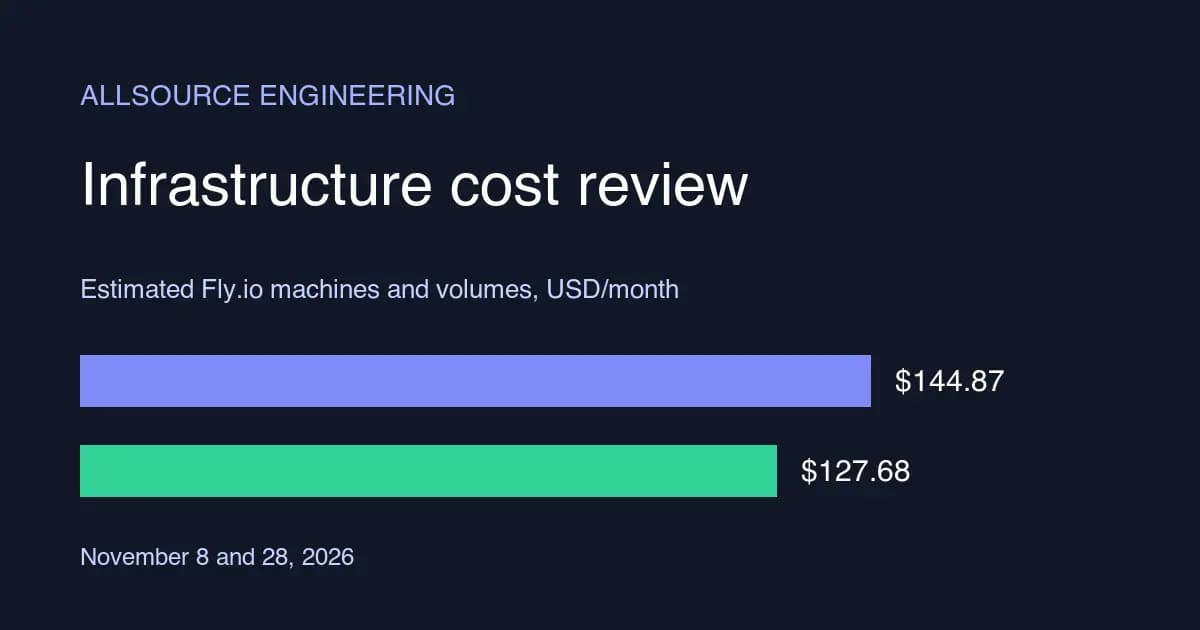
How AllSource cut its estimated infrastructure run rate by 12%
A production cost review shows where $17.19 per month came out of AllSource’s Fly.io footprint and why we kept the event store on 16 GB.
How to Test Agent Memory After Context Compaction
Use a synthetic fixture to check whether an agent can recover decisions, corrections, and source references after compaction or a fresh session.
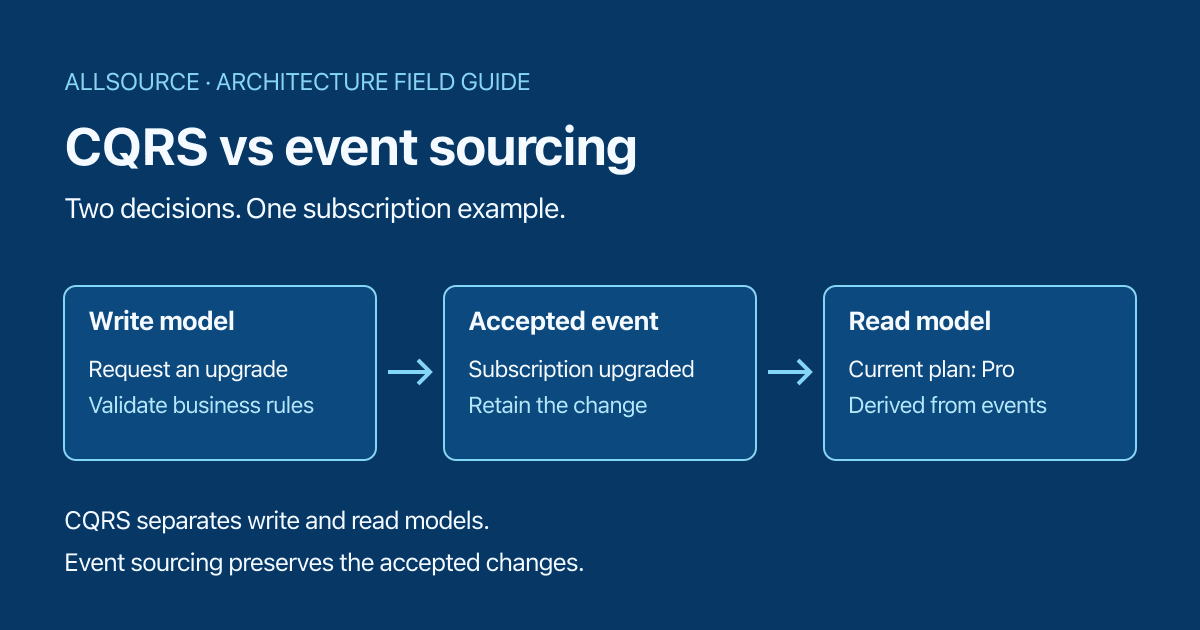
CQRS vs Event Sourcing: A Worked Subscription Example
CQRS separates read and write models. Event sourcing preserves changes as history. Use a subscription example to choose either, both, or ordinary CRUD.
Write → inspect → query
Store one real event, then query it back.
Start with hosted AllSource, or run the Apache-2.0 core on your own infrastructure. Both use the same event model and APIs.